Dr. Adams is a Board-Certified plastic surgeon serving Dallas, Plano, and Fort Worth Areas in Texas. Ranked #1 for Breast Augmentation on Newsweek’s list of America’s Best Plastic Surgeons 2021.
About Breast Augmentation Surgery
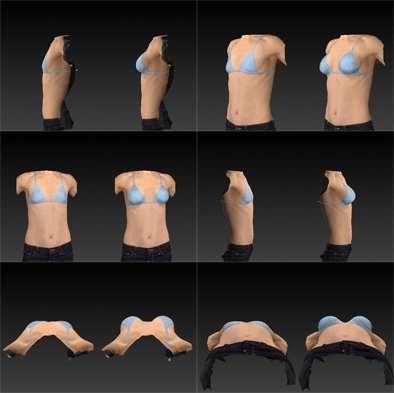
Dr. Adams specializes in breast and body contouring procedures and is world-renowned for his innovative 24-Hour Recovery Breast Augmentation approach. He offers all types of implants on a case-by-case basis, including cohesive silicone gel and saline. Our office utilizes an interactive pre-surgery 3D-imaging technology, enabling our patients to accurately see what they will look like after surgery.
- 24 Hour Breast Augmentation Recovery
- What is Breast Augmentation?
- About Breast Anatomy
- Consultation & Breast Implant Selection
- Cup Size and Breast Volume
- Facts About Breast Enlargement
24 Hour Breast Augmentation Recovery
View more videos like this in our Video Gallery
Dr. Adams has implemented several specific techniques that minimize tissue trauma, which decreases post-operative pain. This 24-Hour Rapid Recovery allows his patients to return to normal activities within 24 hours after surgery.
Everyone has their own personal reasons when considering breast augmentation. Some of these reasons include:
- Enlarging the breasts to make the body proportional
- Restoring breasts that have lost shape/volume due to breastfeeding or aging
- Balancing the appearance of asymmetric breasts, differing in size or shape
Whatever your reason, the breast augmentation journey is different for all…but recovery doesn’t have to be.
The average healing time for breast augmentation surgery is anywhere from four to six weeks. The common surgical approach requires money, pain, bulky bandaging, and excessive downtime. Many patients are advised to avoid physical exercise and refrain from resuming work or picking up their children; and it often requires prescriptions of narcotic pain killers. For many women, this adds complications to their personal lives, as friends and family must step in to help pick up the slack, while they rest and recover.
With Dr. Adams’ method for breast implant procedures, patients experience a true 24-hour recovery time. Dr. Adams accomplishes this by utilizing his 14-point plan that is published in one of his academic textbooks, “The Process of Breast Augmentation”, along with unique surgical techniques that reduce overall trauma. This minimizes post-operative pain right away and dramatically shortens the recovery time. Instead of prescribing potentially addictive and dangerous narcotic pain medicines, Dr. Adams’ patients partake in a simple Ibuprofen regimen to aid in managing mild inflammation and muscle soreness. The initial pain level is comparable to ordinary discomfort after a strenuous upper-body workout.
Dr. Adams has documented this revolutionary 24-Hour Recovery process in peer-reviewed medical publications and is recognized worldwide by his expertise. Ninety-nine percent (99%) of his patients return to their normal routine within 24 hours or less. He encourages his patients to mobilize immediately after surgery through a series of light arm-raising exercises, which promotes muscle stimulation to decrease stiffness and swelling.
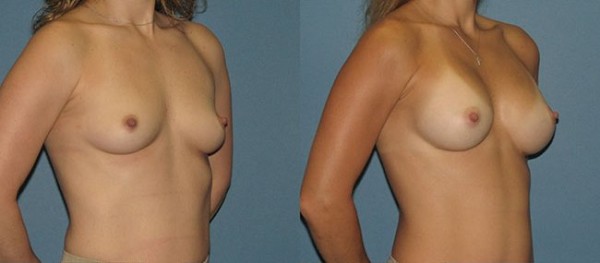
WHAT IS BREAST AUGMENTATION?
Breast augmentation is a safe outpatient operation for improving shape and expanding size of the breasts. While it is considered to be a major procedure, insertion of the proper-sized implant under-the muscle / breast tissue, is minimally invasive.
Breast augmentation enhances inherent breast dimensions and contour, and may give your body a more harmonious balance. Breast augmentation can also dramatically restore breast and body proportion after pregnancy. Furthermore, breast implant surgery may be performed in conjunction with a breast lift; and acceptable with specific breast cancer treatments or breast reconstruction procedures.
Beyond the physical advantages of this cosmetic procedure, it also provides psychological and personal benefits to the patient; confidence, improvement of overall health, empowerment, sexual satisfaction. Breasts are embraced as an essential, beautiful part of femininity.
About Breast Anatomy
The breast is composed of fatty, glandular, and fibrous tissues. Within the breasts are blood vessels, milk ducts, fat glands, and sensory nerves, and a large inferior muscle called the Pectoralis Major. The size, shape, and integrity of women’s breasts vary and are affected by many factors such as age, past pregnancies, natural skin elasticity, and genetics. Some women have a deviation in proportions from right to left, which is called asymmetry.
Consultation & Breast Implant Selection
During the consultation, Dr. Adams will take specific measurements to determine the optimal implant size range and implant type that will fit your breast. These measurements are accurate and predictable, which allows for precise selection.
Our office aims for all patients to get the most out of their consultation experience. Dr. Adams will spend quality time listening to your concerns and make personalized recommendations that appeal to your desired outcome. As a leading expert, educator, and longtime researcher in cosmetic breast surgery, Dr. Adams ensures that you are receiving the best possible guidance and care.
Breast implants have evolved tremendously over time and with the cutting-edge technology we have to access today, they are more advanced than ever. Breast implants are in the Top 10 most studied and commonly used implantable medical devices in the nation. There is a wide variety of FDA approved implants; saline and silicone being the primary options. Saline implants are made up of a silicone outer shell, filled with sterile saline saltwater. Cohesive silicone implants are the most popular today due to their groundbreaking strength and natural appearance. They feature a silicone outer shell, and a viscous silicone-gel filling.
Choosing the right implants is one of the most important aspects of the consultation process. It is imperative to pick the proper size and type of implant that is best for your anatomy. Dr. Adams encourages his patients to be open-minded to his professional suggestions and take time to gather the information they need, so they are confident with their final decision. Ultimately, choosing the appropriate implants will not only give you the best and safest result, but will also increase the longevity of those results.
The state-of-the-art 3D-imaging system we use in our office lets patients “try on” various shapes, profiles, and sizes of recommended breast implants. This helps with visualizing the final outcome and allows you to make a more informed decision.
The 3D-imaging device will scan your body and take multiple photographs from different angles. With powerful computer software, these photo scans are used to create an interactive life-like 3D model of your body. Dr. Adams will review customized options and show you what your breasts could look like with implants. This way, you’ll get a better understanding of which implant you’ll like best.
Cup Size and Breast Volume
Picking the right implant size can be confusing as breast implants are measured in Cubic Centimeters (cc), not bra cup sizes. This is because bra cup sizes are not standard—a C cup from one brand may be entirely different than a C cup from another. Furthermore, a C cup on one patient, may fit differently than a C cup on another patient. Cubic Centimeters are used as an accurate measuring standard. This gives both the surgeon and patient the knowledge needed for a more precise assessment.
If you’re in the Dallas Fort-Worth area of Texas, Dr. Adams has the ability to take 3D scans of your breasts and virtually enhance them to show you how you may look after your surgery. Setup a consultation today to see how we can help!
Facts About Breast Enlargement
Thinking About Having Breast Enlargement Surgery?
Here are a few facts you should know…
1. Reoperation Rate- The NATIONAL Reoperation Rate, in just three years after undergoing a breast augmentation, is at a startling 15-23%. That’s nearly 1 in 4 patients requiring a second correctional surgical procedure, with additional expenses, pain, downtime, and risks. Dr. Adams’ published Reoperation Rate is less than 3%.
 2. Recovery after Breast Enlargement- Typically, recovery after this surgery involves several days of downtime and weeks of strict precautions. During this time period, patients are advised to profoundly limit physical activity. This includes time off work with lost income, restrictions to drive for 7-14 days, inability to care for children and perform basic tasks, along with a necessity for prescription narcotics.
Dr. Adam’s patients experience a Rapid Recovery after breast enlargement. This 24-Hour recovery time permits patients to bypass the inconvenient recovery time that other breast augmentation patients undergo. Hours after surgery, Dr. Adams’ patients are able to get dressed with ease, run errands, go to dinner, hold their children.
Dr. Adams’ approach to careful pre-operative planning & protocols, more minimal surgical technique, and his post-operative instructions, allows patient to avoid the dangers of narcotic painkillers and significantly shortens overall recovery time.
Within the same day of surgery, Dr. Adams’ patients are encouraged to get their body moving. This includes taking a shower and washing their hair, with the ability to raise both arms above their heads.
3. Experience- Not all plastic surgeons have the same expertise, especially when it comes to breast enlargement procedures and implant research. Dr. Adams is a Board-Certified Plastic Surgeon, which not only requires additional education and specialized training, but also includes a challenging written & oral examination. Beyond his certification, he has over 20 years of experience and is recognized as a national authority on cosmetic breast surgery.
He’s published and presented more on this Rapid Recovery in the past five years than arguably anyone else in the world. As an associate professor of Plastics at UTSW and the director of the UTSW Aesthetic Fellowship Program, his passion for educating mirrors his passion for performing surgery and changing the lives of his patients. He developed an elite curriculum for surgeons everywhere, to give them access to learning how to perform breast enlargement surgery in a safer, superior, more rapid manner.
To further educate the community, fellow surgeons, and patients, Dr. Adams is invited annually to attend plastic surgery conferences, where he performs live surgical procedures and shares his mission.
4. Results- As with most things in life, especially in the case of breast enlargement surgery, you typically get what you pay for! Be wary of special discounts– the most qualified surgeons don’t need to lure patients in with low-cost offers. Your decision for breast augmentation surgery should not be based on price. Remember, you are altering your breasts and your body for the rest of your life.
Unfortunately, every week Dr. Adams sees revisional cases from all over. Patients who went with a low-cost option, an unqualified surgeon for convenience, or simply chose the surgeon that could get them scheduled the fastest —only to have problems later down the road, requiring an additional procedure—sometimes multiple procedures are needed for correction. This ultimately compromises future outcomes and adds costly expenses. What seemed to be a good deal in the moment, resulted in an expensive, lengthy, emotional nightmare. Don’t trust your breast procedure with just anyone. Do your research.
Still have questions about Breast Augmentations? Check out our Breast Augmentation F.A.Q. for more information, or feel free to contact us. Our offices are located in Dallas, TX.